Blame It On The Lemon Curd: Musing On The Interconnectedness Of Then & Now

Streetlight on Snowy Day [image created using Waterlogue App]

The Then Part

I DECIDED TO RETURN to writing this personal blog last week while I was making Lemon Curd on a cold snowy day.

No joke

I was using a double boiler, stirring the sugar, egg, butter, and lemon juice that join forces, over heat, to become Lemon Curd. It’s a slow process, that requires nothing more than patience and the ability to keep stirring the ingredients to combine in such a way as to “coat the back of the spoon.”

Standing there at the stove my mind wandered and I remembered who taught me how to make Lemon Curd.

Liz, an acquaintance who’d grown up in Australia, clued me in about how easy and economical it is to make. I met her decades ago when we were citizen volunteers working on a committee to put together a yearlong celebration of our town’s bicentennial.

• 🍋 •

SHE AND I HAD the honor of finding out how much the local country club &/or restaurants would charge for hosting a fundraising that was to be an afternoon tea. We ended up with this assignment because were the only two people on the committee who had been to an afternoon tea in England.

Uh huh

Well, in the process of talking with various establishments we learned that most people in this small town didn’t know what Lemon Curd was. This was something we felt should be at an afternoon tea: me because while studying at the University of Exeter for a term I’d had it at afternoon teas, Liz because it was a normal part of her Australian childhood afternoon teas.

Thus we found ourselves explaining, multiple times, that Lemon Curd isn’t cottage cheese embedded in lemon Jell-O, instead it’s a creamy lemony spread for toast or scones eaten in lieu of raspberry jam or apple butter or grape jelly.

In the end the head chef at the local country club allowed Liz and I into his kitchen so that she could teach him how to make Lemon Curd— which she did. And because of his willingness to learn how to make it the event was held at the country club to rave reviews.

Huzzah!

But most importantly from my point of view, I learned how easy it is to make Lemon Curd. The recipe for which is at the bottom of this post, should you be interested.

The Now Part

YOU MIGHT BE WONDERING, how did this memory prompt me to get back to writing this personal blog?

You see, while stirring the lemon curd, in an unexpected introspective minute, I realized a few things about myself and how this personal blog fits into my current life:

  1. I am grateful and amazed by how lives intertwine and how positive influences can guide you forever.
  2. I am at my best when I’m looking for and acknowledging how interconnected we are, in real life + online.
  3. I am happy and contented when I have a place, like this blog, to share stories + research + insights from my life.
  4. I am peaceful when I let easy things be easy, like writing a blog post about whatever interests me in the moment.

And with that, I’m back to blogging here for a while longer. I’m ready to connect [interconnect?] with gentle readers + kind lurkers and shall do so in this moment by sincerely asking the most obvious question ever asked:

WHAT’S NEW WITH YOU?

• 🍋 •

LEMON CURD

1/2 Cup lemon juice

1/2 Cup sugar

3 eggs, lightly beaten

6 Tablespoons unsalted butter, melted

In a blender, combine juice and sugar blending on high for about 15 seconds. Then add eggs and blend for another 15 seconds. With the blades running, slowly pour in the melted butter and blend for 30 seconds.

Pour the mixture into a double boiler saucepan and bring to a low boil over medium heat. This may take several minutes. Stir frequently.

As soon as the mixture reaches a boil, lower the heat to just above low and stir constantly for 2-3 minutes until the mixture resembles a shiny pudding. It should coat the back of your spoon. 

Pour into ramekins or a bowl. Let cool a little before serving.

Keeps in the refrigerator for up to two weeks. Freezes well.
In Which I Become An Active Amateur Nutritionist: A Story, A List, A Few Questions

Is this not so‽

DESPERATELY [SORT OF] SEEKING CALCIUM FOR STRONG BONES

You’re not a very good freezer spelunker.

Z-D said this to me when I couldn’t find a bag of frozen edamame, a bag that he found almost instantly after digging further down into the disorganized mess that is our freezer.

He was right about me. Our freezer is on the bottom of the refrigerator and looking down into it with my bespectacled eyes is the equivalent of 52 card pick-up. It’s a jumble of blurry stuff.

The thing is that prior to March 2020 in the Before Times we had an organized freezer. I had a place for everything and could quickly easily find what I was looking for.

However after March 2020 when Mr. Man began working from home all the time and we began making all our meals at home all the time I lost control of the contents in the freezer because, say what you will about Z-D, he knows food and likes to have lots of it on hand.

Nonetheless, getting to a point here, you may be asking yourself why was I searching for edamame?

Thanks for asking. Please allow me to explain.

• • •

Edamame, also called soy beans, are a good source of calcium which, as you probably know, is good for your bones.

If I am to believe the results of a recent DEXA scan that measured my bone density, I need more calcium so that my bones get stronger or at least remain as strong as they are now. I’m not into a full-on osteoporosis situation with brittle fragile bones, just a pre-osteoporosis situation that is called osteopenia.

There’s always some dodgy name for medical conditions.

And further if I am to believe my Primary Care Physician’s advice I need to eat more calcium in addition to taking a weekly little prescription pill called Alendronate.

My insurance company [inexplicably] covers the full cost of this annoying little pill. You take the pill on an empty stomach then without laying down you wait at least 30 minutes before eating or drinking anything. I’m a person whose digestive track is easily upset, so naturally the pill doesn’t play nice with my intestines.

There are issues.

Plus the ridiculous dosage regime means that after dragging myself out of bed to face the day there’s no coffee for me for a half hour. I resent this intrusion into my morning routine. Obviously this is not a good way to start my day and I’d like to get to a point where I don’t take this little pill even if it is weekly.

• • •

Admittedly I’m not thrilled with dairy products, a well-known source of calcium. I eat a few but to get the recommended amount of daily calcium [1200 mg] I have to think about taking dietary supplements &/or eating more calcium-rich foods.

Because I want to avoid the dietary supplement angle of calcium intake I’ve chosen to become the Queen of Non-Dairy Calcium Information. As an active amateur nutritionist I’ve researched the topic online, going so far as to put together the following list of sources of calcium-rich non-dairy foods that I would will eat.

I share it here because maybe you, too, are trying to eat more calcium because you, too, don’t like taking prescription medicine or dietary supplements. Thus without further ado I present for your edification this *at least it’s a place to start* list.

[Please note: the order of the foods means nothing more than how I wrote them down during my research.]

A NON-EXHAUSTIVE LIST OF SOURCES OF NON-DAIRY CALCIUM

SOY FOODS

  • Edamame
  • Tofu
  • Roasted soybeans
  • Soy milk [calcium fortified]

NUTS & SEEDS

  • Almonds 
  • Brazil nuts
  • Pistachios
  • Sunflower seeds
  • Almond milk [calcium fortified]

VEGETABLES

  • Spinach [low absorption]
  • Black-eyed peas
  • Broccoli
  • Acorn squash
  • Butternut squash
  • Cabbage
  • Celery
  • Green beans
  • Radishes
  • Sweet potato
  • Tomatoes 
  • Zucchini

GRAINS 

  • Oats
  • Corn tortillas

FRUIT & JUICE

  • Rhubarb [low absorption]
  • Pumpkin
  • Dried apricots
  • Orange juice [calcium fortified]

BEANS

  • Great northern beans 
  • Lima beans
  • Pinto beans
  • White beans
  • Hummus

SWEETENERS

  • Maple syrup 
  • Molasses [blackstrap best]

FISH & EGGS

  • Shrimp
  • Canned sardines 
  • Salmon 
  • Egg yolks

QUESTIONS OF THE DAY

Is your freezer in a jumble or is it organized? If organized how do you keep it that way?

What is your thinking when it comes to taking prescription meds? Or taking dietary supplements?

What is your opinion of dairy products in general? Do you like butter?

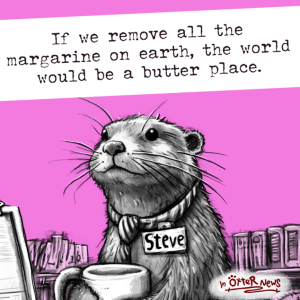
Do you love Steve from in_otternews like I do? Do his absurd thoughts, like the one at the top of this post, make you laugh out loud?

The Mystery Of The Missing Marjoram + Reader Comments About Manufactured Victories

TALKING ABOUT MARJORAM

“I have always relied on the kindness of strangers.”

We needed some marjoram. NEED I tell ‘ya! Zen-Den was making gyros for dinner.

He’d made the tzatziki sauce, bought the feta and black olives and pitas and peppers, but alas and alack when he went to put together the dry blend for flavoring the meat we didn’t have any marjoram.

Thus I went to the grocery to buy some.

Being familiar with our Kroger I knew where the spice aisle was in the store, but when I stood there looking at the shelves with about 3 gazillion jars and containers and bottles of spices and herbs and extracts, I didn’t see marjoram.

In fact, I couldn’t even find a little tag that showed it had ever been on a shelf.

As if, I muttered, knowing it had to be there, right?

So in what for an introvert might be considered stepping outside your comfort zone, I asked two friendly chatty women standing beside me if they saw any marjoram. Turned out they were a mother [70-ish] and her daughter [40-ish] who were enthusiastic about joining my impromptu scavenger hunt in the spice aisle.

Hence we three stood there, positioning our bifocals just so, and looked for the elusive marjoram plus what they were looking for [thyme and poultry seasoning]. We found what they needed, many times over, but the marjoram just wasn’t there.

I shrugged, thanked them for their help and went on my way, walking a few aisles away from the spice aisle to where I knew I needed to pick up something else.

From my favorite webcomic called Underpants and Overbites

But as I was standing in the middle of that aisle, I heard the younger woman yelling “I found it!” as she ran up to me with a jar of marjoram. She handed me the herb and explained that she’d found it with the label turned around backwards, in the wrong spot, hidden behind some oregano.

And then because she was a compassionate foodie person, she’d come looking for me by going up and down the aisles, wanting to make sure I got what I came to the store for.

Bashfully, almost apologetically, she explained that once she started doing something she had to finish it, she was compulsive like that, and this sort of search was her thing.

I had to find it, she told me.

I thanked her over and over, then waved good-bye while thinking, there really are some nice people in this world who don’t want to do anything more than just help other people.

And fortunately for the fate of our Greek dinner, I’d just met one.

QUESTIONS OF THE DAY

Have you ever asked a stranger for help finding something in a store? How’d that go for you?

Do you wonder sometimes how we have evolved into a society in which an act of kindness like this one is so rare that it is almost shocking?

Do you use marjoram in cooking? We have a lot of it now, so any recipe suggestions are welcome.

AND FINALLY FOUR READER COMMENTS…

About the Value of Manufactured Victories:

“Manufactured victories are part of my time management process. Like painting a wall. I get out the paint, then celebrate. Check for the brushes (which I find), dropcloths and tools. Then I celebrate. Now I notice I forgot something and need a store run. The good news-bad news is that I get to celebrate when I come home. All this celebrating and I haven’t yet painted the dang wall!”

~ Kate Crimmins

“… every blog post is its own victory–over apathy, inertia, and sometimes technology…. I feel like failure gets a bad rap in our winner-centric country. I’d like to normalize failure, especially for our kids. You might not have won, but you learned a ton!”

~ AutumnAshbough

“I think manufactured victories are very similar to moral victories, where the object was not to win but to actually try real hard. (Of course, a win is nice, too.)”

~ John Holton

“I don’t agree with the Vulcans that the DS9 crew had manufactured their victory. They were victorious in their sportsmanship. They didn’t begrudge the Vulcans their win, but the DS9 team had fun and experienced healthy camaraderie by showing up and playing together.”

~ Marie A Bailey

Learn Something, Make Food: My Report On Granola & My Recipe For It

Be forewarned, I wondered about the origin of granola and ended up going down a heck of a rabbit hole…

MY REPORT ON GRANOLA

Our story of granola starts in prehistoric times

The history of granola is intertwined with oats, a wild grain that was probably first cultivated by the prehistoric inhabitants of Central Europe.

No one is certain about the origins of oats but all agree that once milled the resulting oatmeal, when cooked, is easy to digest, healthy, and economical. It is the basis for many breakfast dishes, then and now, most notably porridge.

Granola owes a debt of gratitude to oats.

Fast forward to the 19th century

In the late 1800s as the US population became more health conscious, Dr. James Caleb Jackson of the Our Home on the Hillside health spa of Danville, NY, developed a dry cereal that he called “granula.” It was the first processed breakfast cereal in the US.

Granula involved oatmeal and twice-baked zwieback mixed together. It was disparaging referred to as “wheat rocks” and was intended to be a healthy grain-based alternative to a breakfast of bacon and eggs.

At about the same time Dr. John Harvey Kellogg of the Battlecreek Sanitarium of Battlecreek, MI, learned about Dr. Jackson’s granula and stole the idea of it. Kellogg, more businessman than doctor from what I can tell, renamed his product “granola” to avoid a lawsuit by Dr. Jackson.

Continuing into the early 20th century

Even though recipes for granula existed, like the popular one by The Sisters of the Brethren Church, Kellogg’s name for the cereal became associated with the product.

Ironically one of Kellogg’s patients at his sanitarium, a Mr. Charles William Post, stole the idea of Kellogg’s granula/granola and created his own version if it called Grape-Nuts.

Meanwhile in Europe in the early 1900s a Swiss nutritionist Dr. Maximilian Bircher-Benner of a sanitarium in Zurich created a dry grain-based cereal [because apparently who wasn’t?].  He called it “muesli” and his recipe involved oats, nuts, and dried fruit.

Fast forward to the 1960s

Because of the hippie movement granola made a comeback in popularity. Cups of it were popular at Woodstock in 1969.

Sometimes referred to as Sunshine Happy Hippie Granola, this homemade granola was made from a recipe that in essence combined Jackson/Kellogg’s idea of “granula/granola” with Bircher-Benner’s idea of “muesli.”

The new hippie granola hit mainstream America in the early 70s. This reinvented crunchy granola was much sweeter than earlier recipes of granola. It was manufactured by many large food companies, advertised on TV, and became associated with healthy eating despite its high sugar content.

Sources

BREAKFAST DISHES Granula, a recipe by Sister Amanda Witmore, of McPherson, KS, found in The Inglenook Cookbook by The Sisters of the Brethren Church [1906]

Chapter 2, BREAKFAST A History by Heather Arndt Anderson

Charles William Post, Wikipedia

Granola, wordnik

Granola Girl, THE NIBBLE, The Webzine of Food Adventures

Granula, Wikipedia

Jackson Sanitarium, Dansville NY, via #ArtofAbandonment on YouTube

James Caleb Jackson, Inventor of Dry Breakfast Cereal, MENTAL FLOSS

John Harvey Kellogg, Britannica

Maximilian Bircher-Benner, History of the Bircher-Benner Clinik in Le Pont

Peace, Love And Granola: The Untold Story Of The Food Shortage At Woodstock, HUFFPOST

Sunshine Happy Hippie Granola, a recipe by Donna found in Woodstock- Preservation Archives [1969]

THE CEREALS, OR GRAINS., Science in the Kitchen: a scientific treatise by Ella Ervilla Kellogg [1893]

The Origin and History of Granola, CULINARY LORE, Food Science, History and much More!

The Process of How Oatmeal is Made, The Clinton Courier of Clinton, MS

THE SUGAR CONTENT OF GRANOLAS Jane Brody’s Nutrition Book [1980]

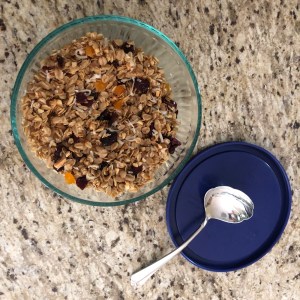
MY RECIPE FOR GRANOLA

2 Cups Old-Fashioned rolled oats

1/3 Cup olive oil

1/3 Cup maple syrup

1/4 teaspoon cinnamon

1/2 Cup coarsely chopped blanched slivered almonds

1 Tablespoon sesame seeds

1/2 Cup dried cranberries &/or dried apricots

1/2 Cup flaked sweetened coconut

Preheat oven to 300ºF.

Scatter oats over a large rimmed greased baking sheet and toast for ten minutes, stirring frequently. Remove from oven.

In a saucepan on the stove top, combine oil and maple syrup then bring to a boil – cook for one minute. Remove from heat and add cinnamon, mixing throughly.

In a large bowl, combine almonds and sesame seeds, add toasted oats, then mix together. Pour the oil/syrup mixture into the bowl and mix thoroughly.

Spread mixture in a thin layer on the baking sheet and return to oven. Toast for 20 minutes, stirring often, until light brown.

Pour into a bowl, add coconut and cranberries &/or apricots, then mix.

Store in the refrigerator. Freezes well.

~ ~ ☮️ ~ ~