#ThursdayDoors | Visiting A Carillon, Learning About Said

Today I’m joining Thursday Doors, hosted by Norm Frampton, so that I can share with you the following door + gate photos– and a bit of information about carillons.

I took these photos at Dogwood Park in Mariemont, OH. It is a village east of Cincinnati, OH, and is one of the nation’s first planned suburban communities. The park is charming and within it is the Mariemont Bell Tower, a carillon with 49 bells.    

Carillons are musical instruments that contain at least 23 cup-shaped tuned bells. Often, as is in the case of this particular carillon, the bells are hung in a belfry and are connected to a keyboard. When a musician hits the keyboard, using his or her fists, each bell rings, creating a pleasing loud sound.

There are only 166 traditional carillons in the United States, and many of them are on university campuses or in city parks, like this one.

Here’s what I saw in Dogwood Park on a sunny summer afternoon. The whole place looked like it belonged on a Hollywood movie set– that’s how perfectly maintained it was.

~ • ~

GATED DOORWAY into Mariemont Bell Tower.

~ • ~

Looking up at Mariemont Bell Tower while standing in front of it.

~ • ~
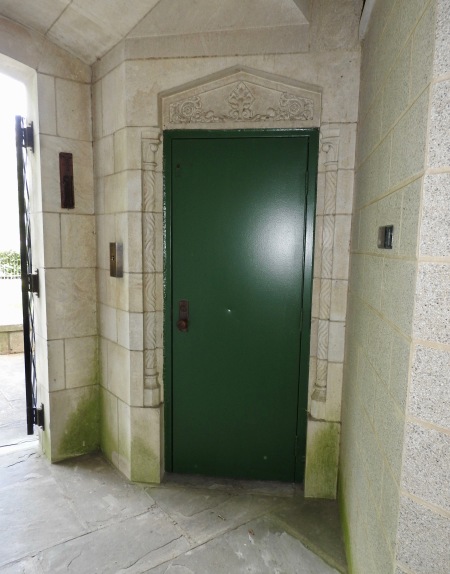
DOOR to restroom within Mariemont Bell Tower.

~ • ~

Side of Mariemont Bell Tower as seen through trees.

~ • ~
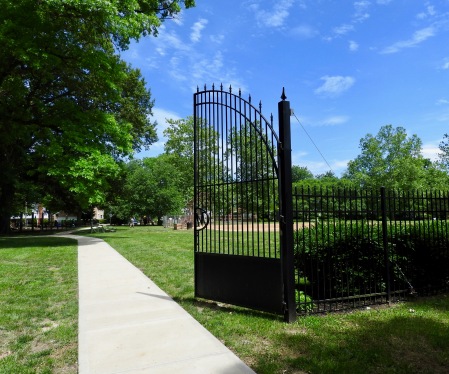
GATE [open] to the park that surrounds Mariemont Bell Tower.

~ • ~
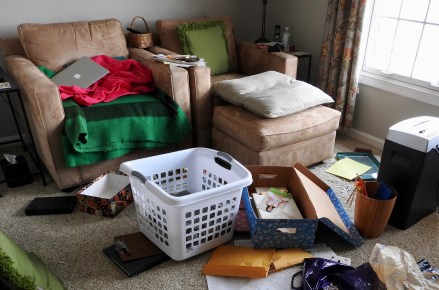
The Stuff Of Family & Ancestors: Thoughts While Sorting Through Boxes

Does this make me feel more alive?

[The question to ask. Always.]

I’ve been in a deciding frame of mind this month. Must get rid of a past that doesn’t serve me.

A past that in many cases is not mine, but I reluctantly accepted and boxed up when elderly relatives passed on, storing their stuff in my closets, I did.

Now, I want empty closets, the feeling of lightness.

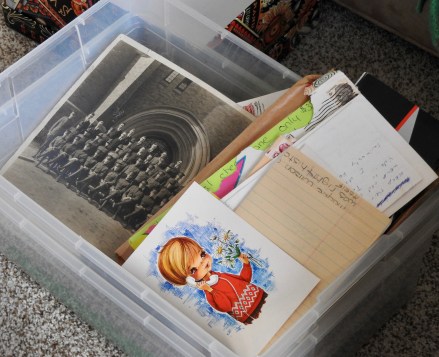
Been going through dusty boxes of old family photos and documents and letters. Pamphlets and newspaper articles.

Memorabilia, too.

Does this make me feel more alive?

I shred the photos and docs and letters that don’t call to me, and save those that might… might… might… someday find their way into…

a blog post?

an article or essay?

a memoir, perhaps, even?

But as for the family memorabilia, it’s a different kind of past. Remembered with objects, things of history.

Personal cookbooks;  and 1940s slides [with a projector];  and  handwritten family stories;  and a diary;  and a daguerreotype;  and [of all things] a Civil War soldier’s personal mirror with carved initials.

What shall I decide about these objects, I wonder.

Does this make me feel more alive?

Difficult for me, an adult orphan, to know what to do with these things that held memories for someone who is long gone. Someone who I may never have met.

I intend to make peace with these objects, sending them on their way…

to history museums or libraries?

to antique malls?

to the dump?

I’ve been a good relative, respectful, but now I’m ready to have more space, both literal and figurative, in my life. Must get rid of a past that doesn’t serve me.

Does this make me feel more alive?

Be The Light: Of Washing Machines & The Retirement Scene

I’ve joined in a yearlong monthly event called We Are The World Blogfest.  

The purpose of this event is to highlight positive news stories, presenting them on your blog on the last Friday of the month.

This being the last Friday of February, I have a positive story to share with you, my gentle readers. 

* * *

THE NEWS STORY:  

Lee Maxwell, a retired electrical engineering professor who lives in Colorado, collects washing machines.  His washing machine collection, stored in two warehouses, consists of nearly 1,500 machines.

Maxwell, age 87, finds the machines all over the United States.  They’re usually in disrepair.  He gets the machines to his warehouses where he repairs them, and stores them.

He has what is believed to be one of the largest personal collections of anything in the U.S.A.  His hope is that someone, a benefactor, will build a museum dedicated to washing machines so that everyone can see for themselves how washing machines have changed over the years.

[Complete story with video: Washing machine collector takes a whirl back in time]

* * *

* * *

MY COMMENTARY:

This story is a quirky happy news story that makes me appreciate people who follow their own muses.

What’s not to love?

A retiree finds a hobby, that turns into a passion, that ends up preserving pieces of history that are easy to overlook.  And suddenly there’s a collection worthy of note because someone, Maxwell, took the time to notice.

I give props to this man.  He didn’t start collecting washing machines to be a news story.  No, he just did it for something fun to do, and in the process saved an interesting part of American history.

I consider him an inspiration.  Think about it, when it’s time to retire we all should be so fortunate as to stumble upon a hobby that takes us down uncharted roads, while filling our hours with a quiet sense of accomplishment.

* * *

#ThursdayDoors | Visiting Fort Pulaski [Not Moultrie], An American Civil [Not Revolutionary] War Site

PLEASE NOTE: It’s been brought to my attention by my husband that these photos are from Fort Pulaski, south of Savannah, GA.  I had my forts wrong.  However, considering that Fort Pulaski is named for a Revolutionary War general my idea of posting these pics on George Washington’s birthday still makes sense.

• • •

Today, in honor of George Washington’s birthday, I’m joining Thursday Doors, hosted by Norm Frampton, so that I can share with you the following door photos + a little bit of American Revolutionary War history.

I took these photos last April when we visited Fort Moultrie, on Sullivan’s Island, SC.  

The fort is named for a Revolutionary war general, who, on June 28, 1776, defended Charleston, SC, from the British.  Since then the fort has been rebuilt a few times and gone through a few more wars.  At the end of WWII the fort closed.  

The day we visited Fort Moultrie Pulaski the weather was sunny and mild, lending an unexpected peaceful vibe to the entire well-kept large complex.  

~ • ~

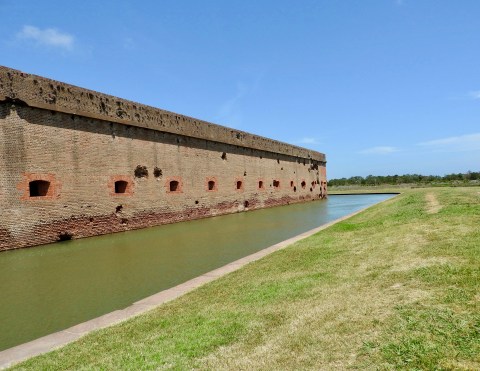
Outer perimeter of Fort Moultrie Pulaski, surrounded by a moat, with visible cannon ball damage on the brick wall.

~ • ~

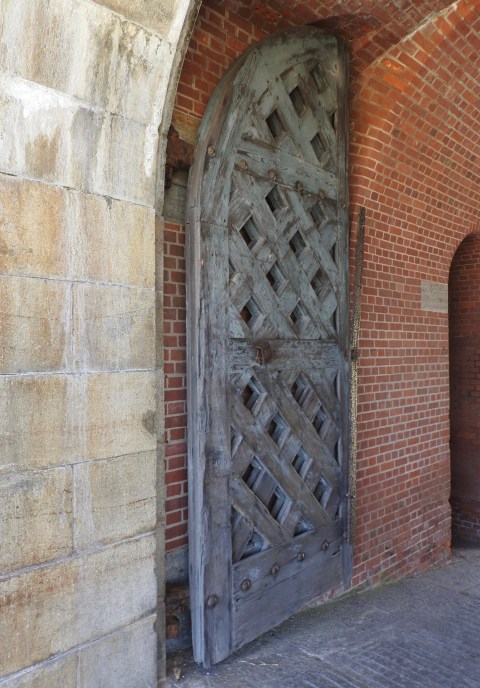
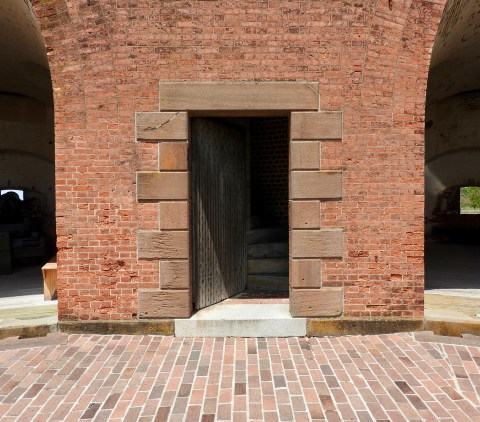
DOOR leading into interior of fort.

~ • ~

DOORS on one small part of the storage area that forms the perimeter of the inside of the fort.

~ • ~

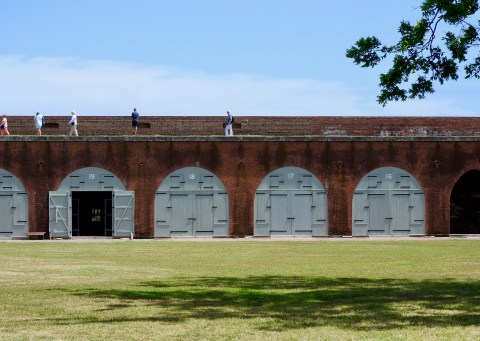
DOORS in a row leading to storage areas shown with people walking above the storage areas to give a sense of scale.

~ • ~

DOOR into stairwell that goes up to the area where people were walking.

~ • ~

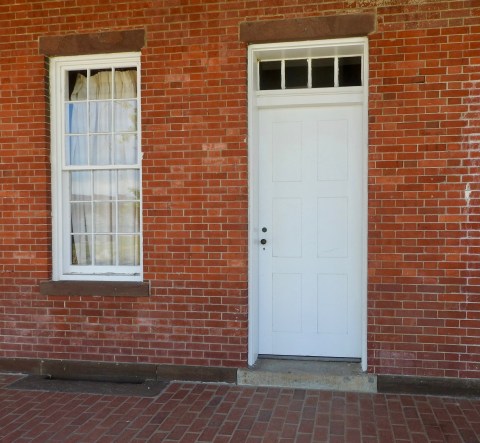
DOOR into officers’ quarters.

~ • ~

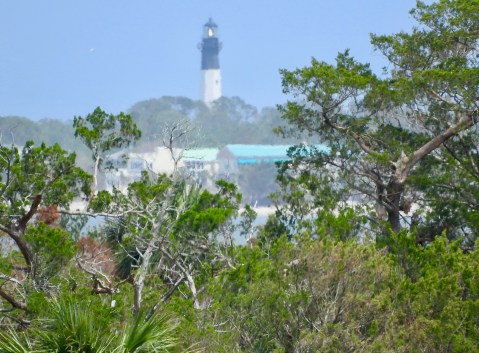
Photo of lighthouse in Charleston Harbor as seen from Fort Moultrie Pulaski.

~ ~ • ~ ~