More Links For Eggheads: Know Thyself Better Edition

… because information is FUN dammit.

• • •

“What’s in a name? that which we call a rose. By any other name would smell as sweet;” ~ William Shakespeare, Romeo and Juliet

• • •

√  to grasp the implications of what it means to be your age, go here.  MILDLY UNSETTLING.

√  to find out what your birth month color says about you, go here.  FUN.

√  to determine which goddess you are and how to dress yourself like she would dress today, go here.  INFORMATIVE.

√  to understand how your emotional intelligence influences your personality, go hereFASCINATING.

√  to learn which Shakespeare character you are, go here.  JUST BECAUSE.

• • •

As Unlikely As This Sounds, We Visited A Midwestern Castle

ONCE UPON A TIME… a few weekends ago… Zen-Den and I finally visited a southern Ohio castle that I’ve heard about for decades.

The Castle and the surrounding gardens are officially named Chateau Laroche.  They were built by an eccentric genius named Harry Andrews, who after serving in WWI decided to promote peace and build his own castle based on the ones he saw in Europe during the war.

First, he used his smarts to become a knight by creating his own order, The Knights of the Golden Trail.  Then he built his castle using, among other things, the stones he found along the river.  After he built most of the castle, he moved into it and lived out his days in the slightly modernized parts of Chateau Laroche.

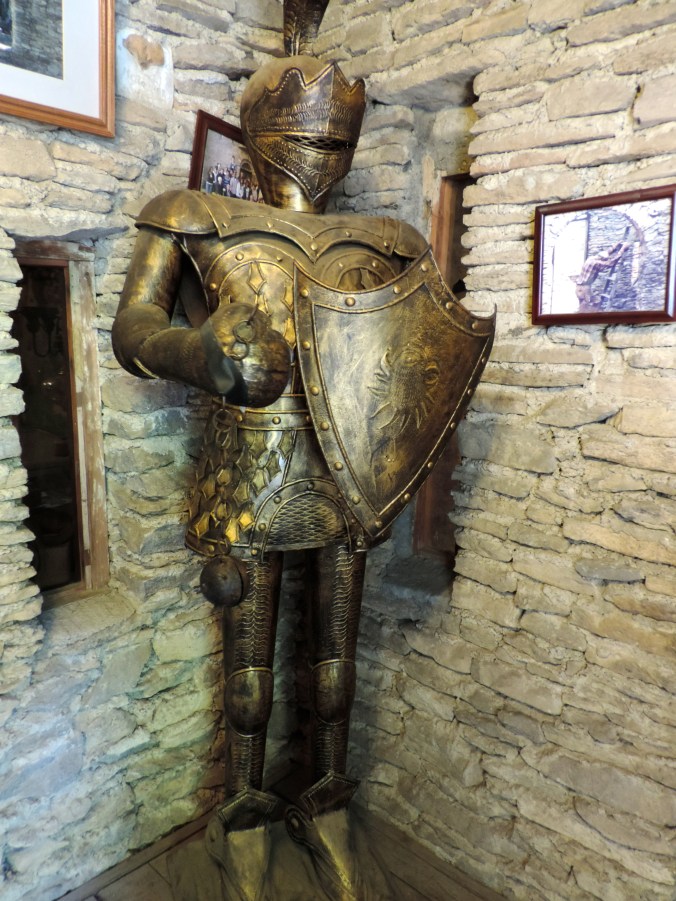
The castle, which is open to the public on a limited basis, is one of the most unusual, almost dilapidated historical properties I’ve ever wandered through, over and around.  Here are some photos.

~ • ~

DSCN2570

~ • ~

DSCN2631

~ • ~

DSCN2545

~ • ~

DSCN2528

~ • ~

DSCN2515

~ • ~

DSCN2530

~ • ~

DSCN2611

~ • ~

DSCN2606

~ • ~

Project Hummer Is Not Going Well

DSCN2685

– • –

I’m sad to report that my grand plan for turning one corner of our deck into a small hummingbird garden/feeding station is not going well.  It’s not for lack of cuteness, I tell you.

– • –

Here’s what I’ve done.

√  3 pots of annuals: 1 dark red geranium, 1 hot pink calibrachoa, 1 fuchsia portulaca

√  1 sturdy wrought iron shepherd’s hook attached to side of deck

 1 hand-painted hummingbird feeder with red plastic pretend flowers that allow the hummers to drink, but thwart the bees

√  1 32 oz. hummingbird nectar concentrate, chilled in our fridge, then mixed with fresh water using an old Pyrex glass measuring cup to insure proper proportions

– • –

No, it’s not me that’s causing trouble with the hummers.  It is, I’m sad to report, Fuzzy the Squirrel and his partner in crime, Khaki, who are causing Project Hummer to fail.

Apparently the sweet nectar in the pretty feeder is too much for them to pass up, so they’ve found a way to tilt the feeder on its side allowing the sweet nectar to dribble onto the ground below where they can enjoy it at their squirrel-y leisure.

– • –

This means that until I figure out a way to keep Butch Cassidy and the Sundance Kid of squirrels away from the hummingbird feeder, my grand plan is on hold.  And all those amazing little hummers who live behind our house in the woods will have to feed themselves on the 22 pink or red or peach rose bushes that surround our house.

The little birds will survive, but I won’t get the fun of seeing them drink up each day… all because two sneaky, uncooperative squirrels have found the best nectar bar in town.  Humph.

That Place Where Genealogy & A Forgiving Spirit Meet

“It is a duty to forgive everyone that is indebted to us, under pain of the Divine condemnation… for an unforgiving spirit cannot possibly be a happy one.”

~ The Reverend William H. Sutherland, Ohio frontier circuit preacher | DDiv | my great-grandfather

~ • ~

Good thought, eh?  I stumbled upon it when I was doing some random genealogical research.

[Amazing what a person can find online.]

The quote you see above comes from Charles C. Cole’s Lion of the Forest: James B. Finley, Frontier Reformer, a biography about Finley.  Like Finley, my great-grandfather was a frontier circuit preacher who travelled via horse or on foot to spread the word of God.  It was a difficult life and the pay was nominal.  Most men did the job for a few years and then moved onto something less strenuous, less religious.

However, my great-grandfather toughed it out and eventually went on to earn an advanced degree in theology.  Throughout his subsequent career as a reverend he rose within the ranks of the Methodist Episcopal Church* to become an elder of some sort.  [More research needed.]  But before he became someone of note within the church, he ruffled a few feathers out there on the circuit.

[Specifically, the feathers of Finley.]

As I understand it, Finley and my great-grandfather did not agree on what constituted Christian forgiveness.  Finley believed that a Christian could not forgive someone unless that someone had first repented.

My great-grandfather took a more progressive view and said that forgiveness was not dependent upon someone else repenting, but was an action that a good Christian took as a matter of course.  The responsibility to forgive was the appropriate behavior of the forgiver, regardless of what the person requiring forgiveness did– or did not do.

[You still with me here?]

I like learning that my great-grandfather, who is affectionately known within this house as The Old Coot, was not as coot-ish as I imagined him to be.  My take-away from this is that he had a good heart, and apparently the sense to know what to worry about and what to let go of.

Rather modern thinking, for an old-time religious fellow.  I’m impressed.

* In 1844 there was a schism within the U.S.A. Methodist church resulting in the denomination dividing into two factions: the Methodist Episcopal Church condemned slavery;  the Southern Methodist Church allowed slavery.  This schism foreshadowed the Civil War by about 20 years.